

SCHOLARSHIP APPLICATION: (Deadline: APRIL 30th, 2027)
Please ensure all fields are filled in completely.To view previous winner: Click Here
(IF YOU HAVE ANY QUESTIONS, PLEASE EMAIL THE PROGRAM ADMINISTRATOR AT RYAN@STUDENTSCHOLARSHIPS.ORG)
Transmissions for Forklifts
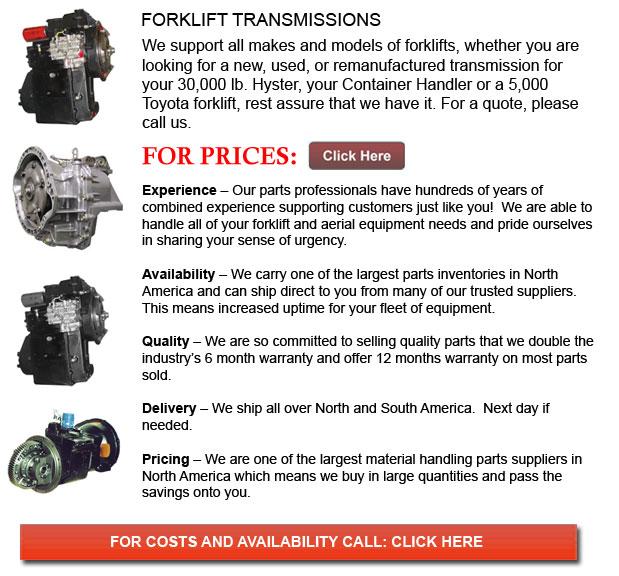

Transmissions for Forklift - Utilizing gear ratios, a gearbox or transmission provides torque and speed conversions from a rotating power source to a different machine. The term transmission refers to the entire drive train, along with the final drive shafts, differential, gearbox, prop shafts and clutch. Transmissions are most normally utilized in vehicles. The transmission adapts the output of the internal combustion engine in order to drive the wheels. These engines must operate at a high rate of rotational speed, something that is not appropriate for starting, slower travel or stopping. The transmission raises torque in the process of decreasing the higher engine speed to the slower wheel speed. Transmissions are even utilized on fixed equipment, pedal bikes and anywhere rotational speed and rotational torque need change.
Single ratio transmissions exist, and they work by adjusting the torque and speed of motor output. Numerous transmissions have multiple gear ratios and can switch between them as their speed changes. This gear switching could be carried out automatically or by hand. Forward and reverse, or directional control, may be provided too.
In motor vehicles, the transmission is usually attached to the crankshaft of the engine. The transmission output travels through the driveshaft to one or more differentials and this process drives the wheels. A differential's most important purpose is to be able to alter the rotational direction, although, it could also provide gear reduction too.
Hybrid configurations, torque converters and power transformation are different alternative instruments for speed and torque change. Regular gear/belt transmissions are not the only mechanism accessible.
The simplest of transmissions are simply referred to as gearboxes and they provide gear reductions in conjunction with right angle change in the direction of the shaft. From time to time these simple gearboxes are utilized on PTO machines or powered agricultural machines. The axial PTO shaft is at odds with the normal need for the driven shaft. This particular shaft is either vertical, or horizontally extending from one side of the implement to another, which depends on the piece of equipment. Snow blowers and silage choppers are examples of much more complicated machinery that have drives supplying output in several directions.
The type of gearbox in a wind turbine is a lot more complicated and larger than the PTO gearboxes used in farm machines. These gearboxes change the slow, high torque rotation of the turbine into the quicker rotation of the electrical generator. Weighing up to quite a lot of tons, and based upon the actual size of the turbine, these gearboxes usually contain 3 stages in order to accomplish a whole gear ratio starting from 40:1 to more than 100:1. In order to remain compact and in order to supply the massive amount of torque of the turbine over more teeth of the low-speed shaft, the primary stage of the gearbox is usually a planetary gear. Endurance of these gearboxes has been a problem for some time.
Click to Download the PDF
Forklift Parts


TOLL FREE: 1-888-695-7994
forkliftpartswisconsin.com
Email Us
About Us