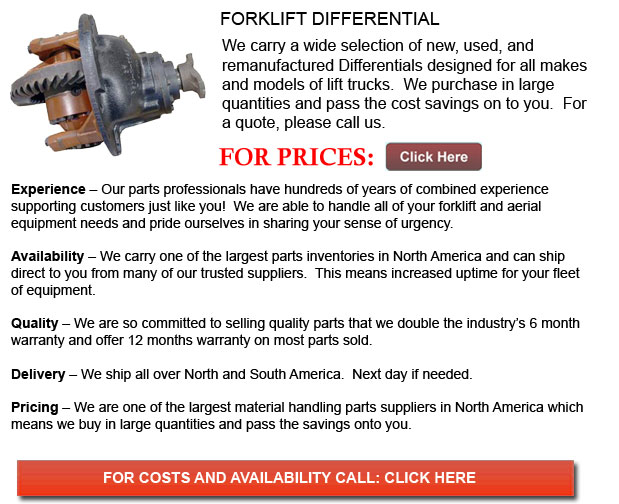

Differentials for Forklifts - A mechanical device which could transmit torque and rotation through three shafts is called a differential. Every so often but not always the differential will utilize gears and will function in two ways: in cars, it receives one input and provides two outputs. The other way a differential operates is to put together two inputs to generate an output that is the sum, average or difference of the inputs. In wheeled vehicles, the differential allows each of the tires to be able to rotate at various speeds while supplying equal torque to each of them.
The differential is designed to power the wheels with equivalent torque while also allowing them to rotate at different speeds. When traveling round corners, the wheels of the cars will rotate at different speeds. Several vehicles such as karts function without a differential and utilize an axle as an alternative. If these vehicles are turning corners, both driving wheels are forced to spin at the identical speed, usually on a common axle that is driven by a simple chain-drive apparatus. The inner wheel must travel a shorter distance than the outer wheel while cornering. Without a differential, the consequence is the outer wheel dragging and or the inner wheel spinning. This puts strain on drive train, resulting in unpredictable handling, difficult driving and damage to the roads and tires.
The amount of traction necessary in order to move whichever vehicle will depend upon the load at that moment. Other contributing elements include gradient of the road, drag and momentum. One of the less desirable side effects of a conventional differential is that it could limit grip under less than perfect situation.
The torque supplied to each wheel is a product of the transmission, drive axles and engine applying a twisting force against the resistance of the traction at that specific wheel. The drive train could usually supply as much torque as necessary except if the load is very high. The limiting element is normally the traction under every wheel. Traction could be interpreted as the amount of torque which can be generated between the road exterior and the tire, before the wheel starts to slip. The automobile would be propelled in the planned direction if the torque applied to the drive wheels does not go over the limit of traction. If the torque utilized to every wheel does go over the traction threshold then the wheels will spin constantly.
Click to Download the pdf
Forklift Parts
Forklift Throttle Body
Throttle Body for Forklift - The throttle body is a component of the intake control system in fuel injected engines so as to regulate the amount of air flow to the engine. This particular mechanism functions by placing pressure on the operator accelerator pedal input. Generally, the throttle body is placed between the air filter box and the intake manifold....
More
Electric Scissor Lift Parts
Parts for Electric Scissor Lift - Lift tables or also referred to as scissor hoists can elevate both people and goods vertically. They are normally utilized in construction, commercial and industrial environments. Normally, the use of a scissor forklift is to lift and lower objects from one floor of a jobsite to the next. These machinery allow ergonomic transfer of...
More
Reach Stacker Part
Parts for Reach Stacker - Used in practically all industrial construction sites, warehouse operations or boat yards, the lift truck is a very important component to help pick up and transport supplies. The reach feature of a forklift could help enhance the applications which the lift truck could complete like for instance stacking pallets on a high shelving unit. A...
More
Portable Manlift Parts
Parts for Portable Manlift - A brilliant way to utilize industrial equipment for a short duration of time is to lease the item from an equipment leasing company. These leasing companies are helpful to homeowners as well as to contracting businesses as they offer a service which enables customers to save a substantial amount of cash on operation expenses. various...
More
Fork Mounted Spreader Bars
Fork Mounted Spreader Bar - Commonly Used Forklift Attachments
Safety cages are essential as a safety feature for forklifts. Normally they are utilized to hoist employees to specific height to allow them to make certain upkeep. Additionally, the safety cage could give them access to stored items at a height. Other items for example, are required to be moved in...
More
Attachment for Hyundai Forklift
Hyundai Forklift Attachments - Hyundai Heavy Industries has been making and supplying numerous sorts of construction tools ever since 1985, along with: wheel loaders, skid steer loaders, excavators and forklifts. The division of heavy industry operates a very efficient and effective product supply system. This particular system is powered by zero-tolerance policy, excellent quality control and amongst the most superior...
More
Attachment for Terex
Terex Attachment - Terex Forklifts stands by their mission to deliver a reliable and cost effective product line. They take pleasure in making equipment that improves their customers' return on investment. Through several divestures and acquisitions intended to expand the product offering, Terex has a short time ago expanded dramatically. They have enhanced their geographic coverage to enable them to...
More
Forklift Mast Bearings
Mast Bearing - A bearing is a device which enables constrained relative motion between at least 2 components, often in a linear or rotational sequence. They can be commonly defined by the motions they allow, the directions of applied cargo they could take and according to their nature of operation.
Plain bearings are normally utilized in contact with rubbing surfaces,...
More